I’ve been donating blood since I was in high school. My dad is a long-time blood donor, so I started giving because he did. Turns out he donates because his dad, my Grandpa Bill, was a long-time blood donor.
In my early 20s I set a goal to donate the largest feasible volume that was meaningful to me as a homebrewer: a keg. A standard half-barrel keg is half of a barrel (31 gallons), so 15.5 gallons or 124 pints of beer. Or blood.
I donated blood yesterday and checked my stats: 53 units with the Red Cross, plus 10 that I donated with LifeSource during the periods I lived in Chicago. That puts me one unit into the second half of my keg.
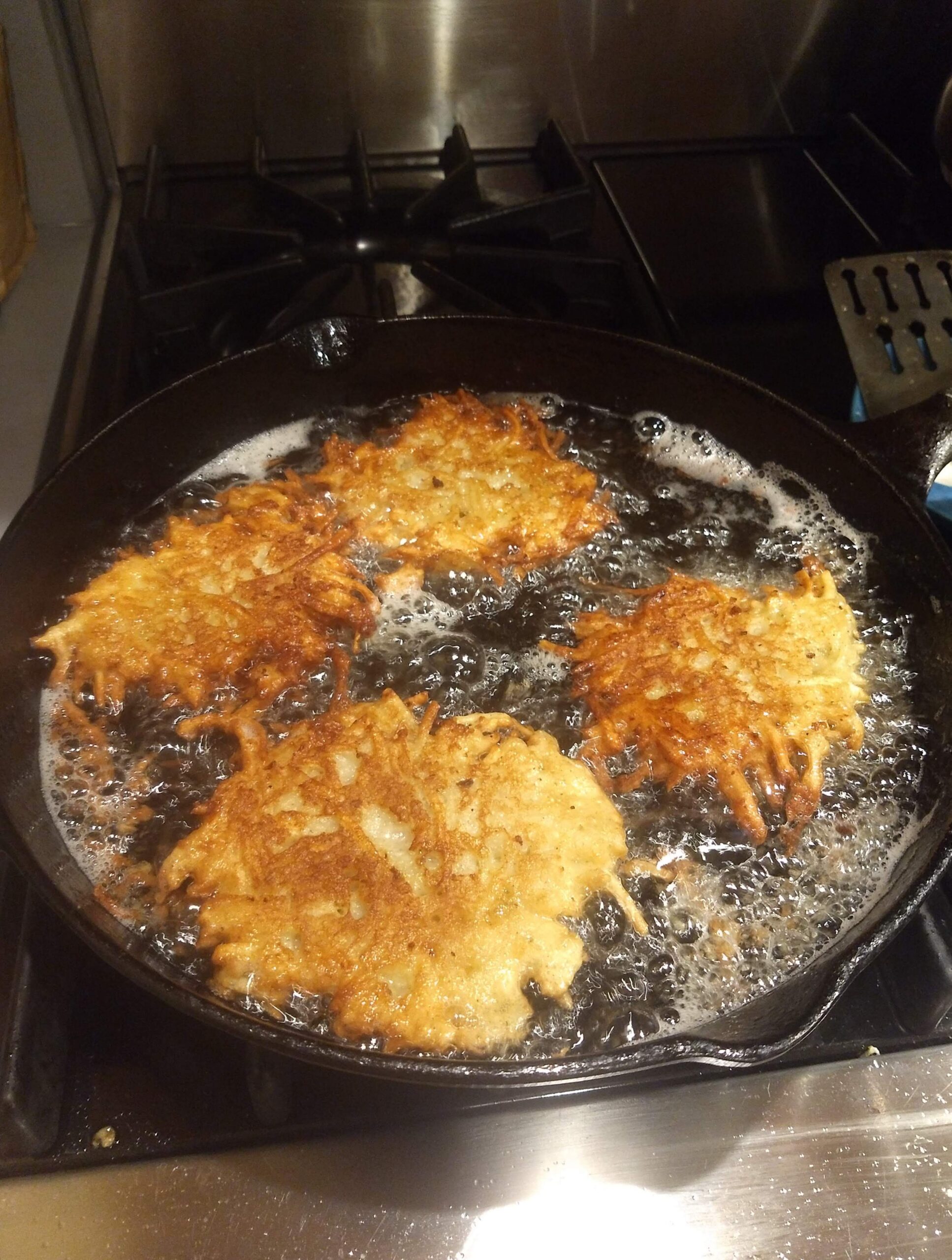
This Hanukkah I locked in my favorite latke recipe, cooking it over and over and taking notes. I’m resharing it here, if nothing else so I can easily find it next December.
I was lucky to celebrate with my brother, who is vegan. We cooked together and over several nights made eight batches of latkes, half traditional and half vegan. We nailed the vegan version: side-by-side, they were nearly indistinguishable.
They were excellent. Pureeing some, but not all, of the potatoes yields a latke with distinguishable strands that is also firmly bound. And they are herbed, which gives them flavors beyond oil and salt. There was no point at which I suddenly felt ugh, that’s enough.
I recently read and enjoyed The Overstory, by Richard Powers. I often miss connections in books & movies that are obvious to others; here I wrestle with one particular line near the end that I noticed is a callback to an earlier chapter.
This post contains spoilers. If you haven’t read the book, you’re better off reading it than this post.
David Zinn, whimsical local artist, is an Ann Arbor treasure. His chalk drawings on sidewalks are fleeting (though I have a few of his prints hanging on the wall), but in 2014 he put up a permanent work: the Singing in the Rain mural on Fifth Avenue. If you stand at the right spot, Gene Kelly appears to be swinging from a real-life street lamp (first photo below). No news here so far.
(I went looking for Zinn’s social media presence so I could link to him and I see he has >300k Instagram followers! I’m not surprised, his work is well-suited for that channel. I’m glad he has a large online following in addition to his local adoring fans).
Walking down Fifth Avenue on a rainy day in October 2017, I stood at the spot where the street lamp aligns with the mural – and noticed something on the sidewalk at my feet. A pair of footprints had emerged to mark where the viewer should stand, along with lyrics to the titular song:
A hidden bonus artwork had revealed itself! These appeared to have been made with stencils and a clear coat that is only visible when it prevents the underlying pavement from moistening – and darkening – during rain. Rainworks has some examples of this medium.
Twice in the past year I’ve walked past that spot in the rain and not seen the hidden art. So I emailed the Ann Arbor Downtown Development Authority (DDA) who had sponsored the mural, to see what had happened and if they could restore it. They didn’t know what footprints I was talking about, and when I shared the photos, they said they’d never known about anything of the sort and couldn’t say what had happened.
I noticed last week that there are some newer-looking sections of sidewalk pavement in that area. If I remember, I’ll compare them to the photos I took in 2017 and see if that explains what happened.
Unresolved is who added the bonus sidewalk art. Was it surreptitiously added by David Zinn? Or by a 3rd party? Its hiding-in-plain-sight nature already made it some of my favorite art around Ann Arbor and its rogue creation only adds to the mystery. I hope the stencils are reapplied! If they’re not, then my photos serve as a memorial. If you know more, comment or drop me a line.
For Thanksgiving 2013, I brewed my first Biere de Garde, after discovering the style and then reading Garrett Oliver’s suggestion that it’s the perfect pairing for the holiday feast. My brew was a hit. At Thanksgiving 2019, we drank the final bottle from that batch.
Friday we drank another final bottle that had been lurking in my cellar, an Eisbock brewed in 2013. Even as many obscure beer styles are pioneered or revitalized in the homebrewing community and then are taken to the public by mainstream craft breweries, Eisbock remains relatively unknown. I expect this is due to the fact that freeze-concentrating beer, at a production scale, would require specialized equipment that most breweries won’t acquire.
Then yesterday we drank the final bottle of a 2011 smoked porter (excellent) and one of the last few of a 2015 smoked porter (one-dimensional).
It may be a stretch to call homebrew art; I see it as more of a craft. Art or craft, it’s something that can only be experienced a finite number of times. The act of tasting it simultaneously depletes it.
You know how new businesses frame the first dollar they earn?
I wrote an R package that interfaces with the SurveyMonkey API. I worked hard on it, on and off the clock, and it has a few subtle features of which I’m quite proud. It’s paying off, as my colleagues at TNTP have been using it to fetch and analyze their survey results.
The company and I open-sourced the project, deciding that if we have already invested the work, others might as well benefit. And maybe some indirect benefits will accrue to the company as a result. I made the package repository public, advertised it in a few places, then waited. Like a new store opening its doors and waiting for that first customer.
They showed up on Friday! With the project’s first GitHub star and a bug report that was good enough for me to quickly patch the problem. Others may have already been quietly using the package, but this was the first confirmed proof of use. It’s a great feeling as an open-source developer wondering, “I built it: will they come?”
Consider this blog post to be me framing that dollar.
Last night my family dined out at Seva, a stalwart of Ann Arbor’s plant-based restaurant scene. The big kids nibbled quesadillas, I enjoyed the “Veracruz” tostada, and the baby toddler gobbled everything including the crayons. It was a nice treat on a Sunday night. The kids noticed that they were the only children in this upscale restaurant.
I paid in cash. Normally I’d use a credit card, but I’ve grown more concerned about Capital One skimming a several-percent cut of each transaction from local businesses. And I had exact change so we could make a speedier getaway, always good with kids.
The big kids were shocked to see the cash I plunked down (there were a lot of ones, so the fat stack caught their eyes). “How much money did you put in there??” They started counting it. “Wow that is so much money!” The 8-year-old gets $2/week as allowance and it would take her over half a year to pay for this meal.
Correct, kids: it was an expensive dinner. That’s part of why it’s a treat to dine out. We’re lucky we can afford it. But if I had charged it, they wouldn’t have realized this or asked questions.
I didn’t expect to spark a conversation by paying cash. It’s conventional wisdom that paying cash makes cost more salient to a purchasing adult, but I’d not seen it apply so clearly to kids too, who are still learning about money. I realized how my paying by credit card abstracts the cost of goods and services to children. Airplane tickets are expensive, but do my kids know that?
This may be a phenomenon of affluence, to have the luxury of charging everything and having kids blissfully unaware of cost. But for those lucky enough to be in that situation, perhaps paying in cash – especially for things the kids consume – will help them appreciate the value of money and be grateful for their good fortune.
The William St. Bikeway officially opened last weekend, though it is not yet finished and is in fact entirely closed in segments as construction is finished. Here I am with my boy at the grand opening:
A street that safely accommodates my four-year-old
I realized I should grab a “before” shot of the Strava cycling heatmap so I can eventually compare it to “after.” [the hardest part of data analysis is collecting the right data]. I took this November 1st, 2019, though a week ago would have been better:
In it we see that William is less popular for East/West travel than either Liberty or Washington. This might have been due to its more peripheral location at the south edge of downtown, confusing lane changes, and higher traffic speeds. The latter two are mitigated by the protected bike lane.
Will we see traffic spike? The biggest increase in ridership will likely be in the non-Strava-using crowd, i.e., regular people. And that will be my explanation if this heatmap looks the same a year from now. I’m not sure if those cycling for sport will find the protected lane more appealing. The data service Strava Metro would allow for better analysis of this question, including looking at those rides tagged as “commutes”, but I don’t have access to that data.
Incidentally, I’m curious about the “advisory bike lane” unprotected segment between First and Fourth. With winter approaching, I don’t expect that segment to be painted anytime soon. An informational poster on William St. describes how it will work and it doesn’t sound like anything I have seen around Ann Arbor.
Most TV and movies are trash, whether for adults or kids. The grownup material loads up on mindless violence or sex to compensate for its underlying dullness and unoriginality. Kids media sells stuff. None of this is news.
But twice this fall I’ve bumped into disheartening synergy that I felt merited a lament: the endless recycling of violent grownup-movie cliches had jumped the track into movies for small children. This seems like the worst direction this could go, though maybe not surprising.
Here is my n = 2 of complaints. I’m sure if I had the misfortune of watching such movies in increments of more than 45 seconds I would have more to rant about.
I wrote about how the cargo bike changed my life. The #1 game changer is how mundane car errands become joyful adventures. Whenever I can, I haul things by bike, and it’s become a game to see what new objects I can haul.
Here are some favorites. Photos 2016-2022.
People
Babies & Toddlers
Babies love the Yepp seat. They start off awake:
look! Sunglasses a must if riding an e-bike
Then quickly doze off (don’t worry, he had his helmet on during the ride):