Categories
How-to Repair

Sand the bottom of a door that sticks without taking it off its hinges

Problem: a wood bathroom door rubs slightly on the tile of a bathroom floor at the midpoint in its swing, sticking in place. I wanted to sand off the tiniest bit so that it swings free.  But it wasn’t worth removing the door from its hinges.

Solution: get some rough sandpaper (I used 60 grit) and an old magazine. Open a dozen pages of the magazine and lay the sandpaper on top, grit up. (Without the magazine padding I’d be nervous that I’d mar the tile floor). Put this stack at a point in the door’s arc where it swings freely.

Before you start sanding: you want to avoid pulling off any strips from a veneer that may be covering the door’s surface.  To avoid that, first sand the trailing edge of the door (that is, the side that hits last when you’re slamming it into the sandpaper), so it isn’t caught and pulled while you slam.  Also consider using a finer grit of sandpaper, which would add a few minutes to the sanding, and opening-and-closing on the sandpaper with less force.  Keep an eye on the veneer throughout the process.

Now, slam the door into the paper stack so that it sticks. In the process, it sands exactly the lowest point on the bottom of the door. Keep swinging it back and forth, slamming it into the sandpaper. As you make progress in shaving the door, you may need to add pages to the stack or move it closer to the point where the door sticks.

Test periodically. In a few minutes you’ve removed a millimeter or two from the bottom of the door and it should swing freely, without altering the look of the door or needing to remove it.

Besides the convenience of this solution, I enjoy its elegance: by replicating the act of making contact with the floor it shaves the door in precisely the right place.

Categories
DIY Making Repair

Mending knee holes with sashiko

I love repairing things. For several years I’ve hoped to take up sewing to extend my fixing skills to clothing. Sheltering-in-place during COVID-19 has provided opportunities to try my hand at mending ripped knees in my family members’ pants. It feels good to sit in peace and make something whole again. Apparently I’m part of a trend, with mending and in particular visible mending gaining in popularity.

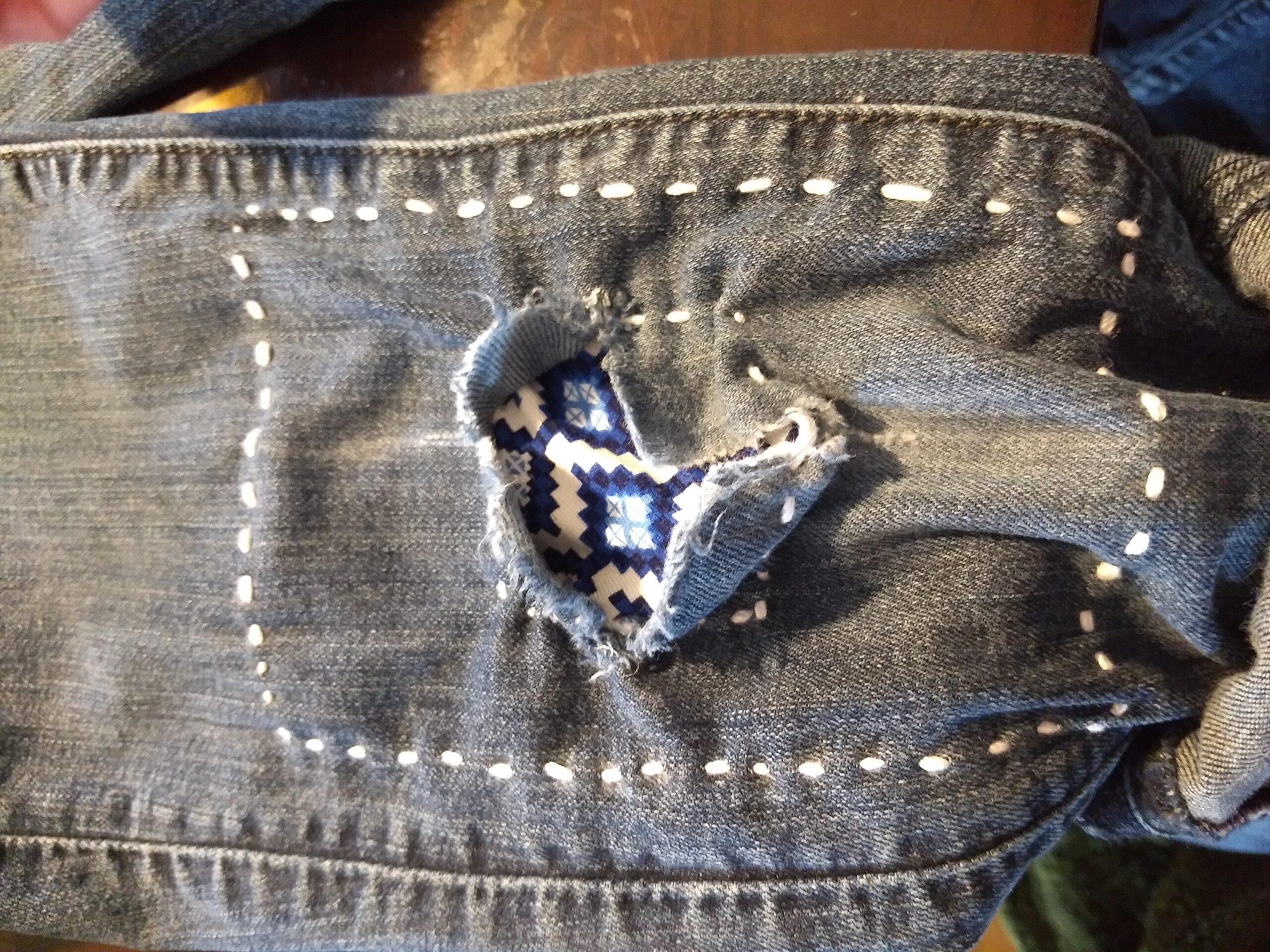
I asked my friend Cassie where to start in mending holes in knees and she pointed me to the book Mending Life, which had steps that were thorough, clear, and seemed doable – with handy illustrations (pp. 96-103). So I took a shot at it. So far I’m 3 of 3! None are perfect but all three exceeded my expectations. Below are photos.

Specifically, I have been trying to emulate sashiko, a Japanese decorative reinforcement stitching technique. I sewed the first patch with a piece of thick thread I found in my sewing box. The next two I did with proper sashiko needles and thread I ordered online. (As with most of my things, if you live near me and want to borrow them, just ask).

I chose contrasting thread and patches to emphasize the repair jobs. I’m proud of my work, it normalizes repair and reuse, and frankly I think the unique & visible mends leave the clothing looking better than it did new.

Sashiko patch : women’s jeans

The ripped fabric at the knee was exploding outwards. It was begging to be patched with the “exposed edge technique” (Mending Life), with an interesting pattern poking through.

Categories
DIY How-to Making

Building a compost bin out of pallets

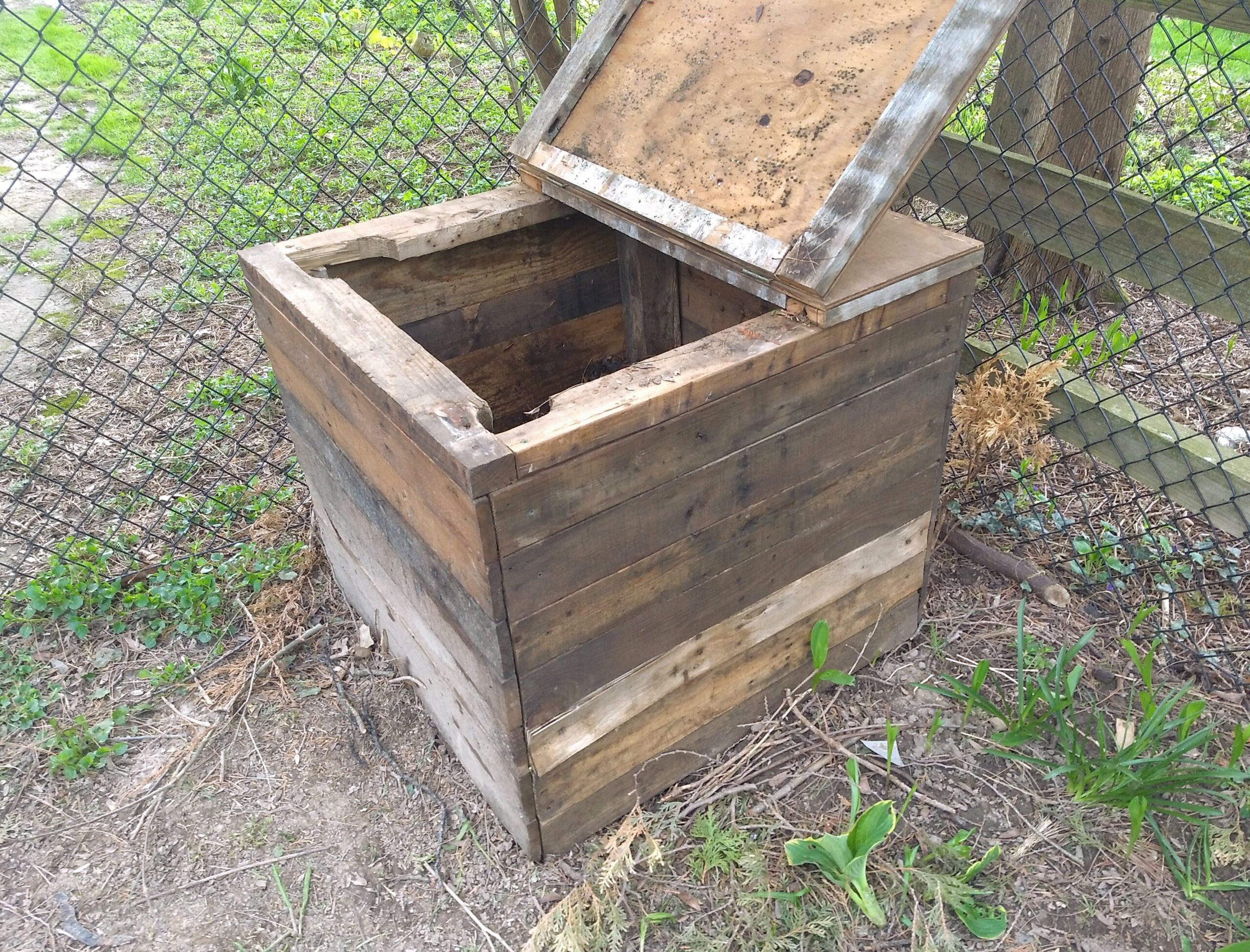
The project: My mother-in-law had long expressed interest in composting her food scraps, but didn’t care for the plastic bins available for purchase. I’d been interested in building such a bin by reusing salvaged lumber, mostly discarded wood pallets. This presented a fun challenge: construct a compost bin that satisfied her aesthetic requirements and followed my principles of reuse.

It turned out well: it’s attractive (in a rustic way) and functional, though took longer to build than I expected. Breaking down pallets was a big chunk of that time overage: they were free in monetary cost but not in the time they took to process.

After weathering its first winter

Design: I built it probably a little too big, 32″ L x 30″ W x 29″ H. Compost bins have to solve for the problem of emptying the finished compost (after a year or so) while leaving in place any recently-discarded food. In bins like this, which will be emptied via a not-yet-installed door in the bottom of the side (see below), that separation is achieved by the depth of the pile. The bottom of the pile, with older finished compost, is no longer turned, while the fresher, unfinished material rests on top. In a narrower bin, the walls support layers of material such that the top layers can be left in place while the bottom is scraped out. This bin may be too big to neatly do that. Perhaps the over-sizing just means it can go a few years between emptying.

Categories
Books Climate change ruminations

On Timefulness

I enjoyed and was moved by the book Timefulness: How Thinking Like a Geologist Can Help Save the World, by Marcia Bjornerud. This post is a review & reflection I’m finishing many months after reading it.

“Rates of technological progress far outstrip the rate at which human wisdom matures (in the same way that environmental changes outpace evolutionary adaptation in mass extinction events).” – Marcia Bjornerud, Timefulness

The book has a few threads going at once but the bulk of it is a geological history of the world, in a more layperson-friendly format than a textbook. It’s heavy on the science and I learned a great deal of earth science. For instance:

Categories
DIY Repair

Drilling through a broken zipper slider and adding a paperclip pull

The slider on my zipper – in this case, on a waterproof bag for holding soiled cloth diapers – broke such that the top of the bridge separated from the slider body. I tried to glue it to no avail.

Two tailors told me they’d need to replace the entire 16″ run of zipper and quoted me $25 and $26. I could get a new bag for that much. So I took a shot at repairing it.

I drilled through the side of the slider bridge, using a 1/16″ bit. I first used a hammer & nail to make a tiny indentation so the bit wouldn’t walk. If the hole is even a little off-center, it will leave a thin border prone to breaking.

I drilled that hole. Like usual, I forgot to take a “before” picture. It looked like any zipper.

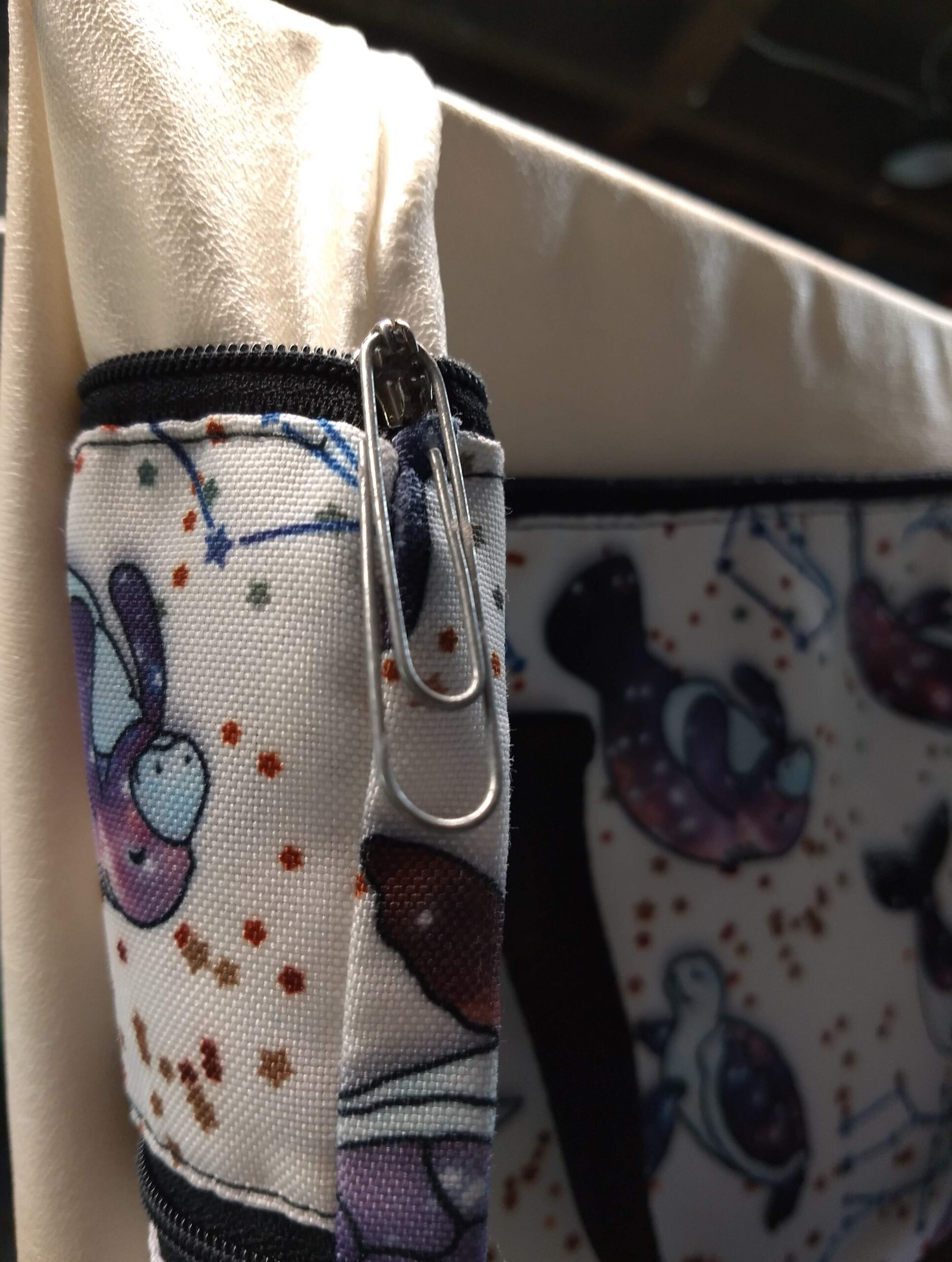
Then I stripped a spare piece of 22 AWG wire I had lying around, bending the copper into a loop. Kind of pretty, I think!

It took just a few minutes and seems to slide well. We’ll see how it holds up.

UPDATE May 2020: the twisted wire was impractical and failed quickly. It has been replaced by a paperclip, which is working much better. The clip falls off in the washing machine, which might pose a risk to the machine. I now remove it before tossing the bag into the wash and reattach afterward. Overall the bag now works as well as new!

Categories
DIY Making

An Excel grocery checklist template

Being in an unfamiliar setting can lead to epiphanies, big and small. Travel is great for this. For instance, I first learned about cargo bikes when I saw one in Brooklyn on a work trip.

In 2012 I stayed in an apartment that had a physical grocery list hung on the kitchen wall. It listed common items – apples, eggs, etc. – and had arrows you could flip to note that you needed something.

I liked the idea. It solves the tricky problem of trying to see in your fridge the things that aren’t there, providing a checklist instead. But you can’t take it with you to cross things off and it’s hard to modify the items as your needs change over time.

So I made an Excel version of this checklist, organized by section of the store and with space to write in custom items. I’ve tweaked it over the years and it’s worked great.

In the spirit of knowledge sharing, I’ve posted it for others to download and adapt. It’s not “open-source” because it’s a Microsoft Excel file. But I share it in that spirit. It should be accessible to regular people who want to make a customized grocery list. I hope someone else can benefit from the time I spent tweaking the formatting!

(don’t judge me for the list contents, everyone is different)

Categories
Local reporting Politics

I voted today, early and without cause

Today’s the New Hampshire presidential primary. That got me thinking it would be a good day to vote in Michigan’s presidential primary, even though it’s not for another month.

In 2018, Michigan voters approved Prop 3, allowing for no-cause absentee voting. Previously, you could only request an absentee ballot if you met certain specific conditions: you’d be out of town, you were over 60 years old, you were in jail awaiting arraignment or trial, etc. Now, in a win for voting access, anyone can request an absentee ballot without stating a reason.

So today I celebrated my birthday by walking over to the city clerk’s office, obtaining an absentee ballot, voting, and submitting it. I avoid any lines on Election Day (March 10th) and can rest assured that my vote is cast. I don’t have to worry about the potential for an unexpected emergency or rush at work. And candidate campaigns can see in their data systems that I’ve already voted, leaving me in peace as they focus their resources elsewhere. (Who has requested, and returned, their absentee ballots is a matter of public record).

Happy Birthday to Me

This isn’t as good as official early voting, like what Illinois has. And it’s not as good as official voting by mail, like Oregon has. But it can be those things in practice if you take advantage of it. Here’s to winning expanded ballot access – and using it!

Categories
DIY How-to Repair

Watch repair: metal spring bar tore a channel in a Casio G-Shock end piece

For Hanukkah 2008, I received a new watch from my wife. (I don’t remember the watch before that). It was particularly magical in my job as a high school teacher. After the first bell of the day rang, it was 4 minutes to the start of school, then 46 minutes per period alternating with a 4-minute passing period.

The watch had a auto-repeating countdown timer that I set for 50 minutes and would synchronize with the day’s first bell. At any point during the day I could look down and see precisely how many seconds were left in a class or passing period. I could walk the hallways and announce “27 seconds!” or count down “5-4-3-2-1” and then the bell would ring, with me the only person in the school who had that level of precision.

After years of daily wear and companionship, I received a smartwatch as a gift and stopped wearing the digital watch. I went from the Fitbit to a Basis and then a Garmin. At one point I realized I’d fallen into a consumerism trap and sought to go back. The notifications were disruptive and the data I was generating was useless to me but creepy in the hands of Big Tech. I tried to go back to the Casio, but it had a problem. (Remember the torn-out spring bar in the page title? This post is about the torn-out spring bar).

Each strap is attached to the end piece / bezel by a spring bar. In the course of replacing a broken band and with wear and tear over time, the spring bar on one strap carved a channel from the hole it sits in. With slight force, the strap would pull the pin out through the channel and detach from the bezel. (If this post wasn’t an afterthought I’d have a “before” picture). This person appears to have the same problem, though they too did not post a picture.

Categories
Biking Climate change Parenting

Motherload, a movie about people and cargo bikes

I saw the documentary “Motherload” in September and meant to write a review.  I wish I had done it fresh, but I keep thinking about it, so better late than never.

Motherload connected with me on an emotional level.  I teared up as it captured on film and described feelings and moments I’ve had biking with my kids that I’ve never heard anyone articulate.  People know I’m the crazy guy on the bike with his kids; this film told my story, our story.  In this post I’ll remark on a few parts that stuck with me.  Here’s the trailer:

Categories
How-to Making

SD card not recognized in Ubuntu after formatting with GParted? Label it

I formatted an SD card for use in a Raspberry Pi, in fat32 format using the GParted and following the steps in this post.

But then Ubuntu didn’t recognize it, so I couldn’t put the NOOBS files on it. I went around in circles before giving the SD card a label, a step described as “if you wish” in that post. Voila! My SD card was immediately recognized.

That’s all. Label the volume. Maybe this brief post helps someone searching the internet, but if nothing else I hope writing this makes me less likely to fall in this same trap again.